

Merging your finances with someone else is a major milestone. Whether you are moving in with a partner, getting married, managing an aging parent’s finances, or starting a casual business venture with a friend, a joint bank account is the most practical tool for handling shared expenses.
However, before you walk into a bank or click “apply” online, you need to understand exactly what is required. Because two (or more) people are taking ownership of the funds, banks require a specific set of documents and verifications from everyone involved.
This comprehensive guide is designed to rank your financial knowledge up to expert status. We will cover exactly what you need to open a joint bank account, the step-by-step process, the different types of joint accounts available, and the crucial pros and cons you must consider before signing on the dotted line.
What is a Joint Bank Account?
A joint bank account is a standard checking or savings account that belongs to two or more individuals. Every person named on the account has equal access to the funds inside it, regardless of who deposited the money.
This means that any account holder can deposit money, withdraw funds, write checks, and make debit card purchases. Importantly, it also means that all account holders share the responsibility for any fees, overdrafts, or negative balances that occur.
Who Should Consider a Joint Account?
- Couples (Married or Cohabiting): To easily pay shared bills like rent, mortgages, groceries, and utilities.
- Parents and Teens: To help young adults learn money management while parents monitor spending.
- Adult Children and Aging Parents: To assist an elderly parent with paying bills, managing medical expenses, and handling daily financial chores.
- Roommates: To pool money for household expenses (though this requires a high degree of trust).
What Do You Need to Open a Joint Bank Account?
To comply with federal regulations, including Know Your Customer (KYC) and Anti-Money Laundering (AML) laws, banks must rigorously verify the identity of every person on the account.
If you are opening the account in person, both of you must be present and bring your original documents. If you are applying online, you will both need to upload clear photos or scans of these documents.
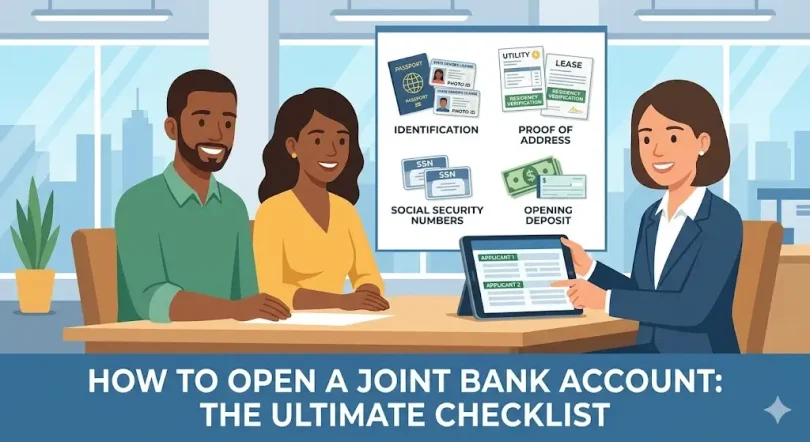
Here is the ultimate checklist of what you need to gather:
1. Government-Issued Identification
Every applicant must provide a valid, unexpired photo ID. The bank uses this to verify your legal name, date of birth, and appearance.
- Acceptable IDs include:
- State-issued driver’s license or learner’s permit.
- Government-issued state ID card.
- Passport (US or foreign, though foreign passports may require secondary identification).
- Military ID card.
2. Proof of Physical Address
Banks require you to prove where you currently live. Even if you and the co-applicant live at the exact same address, you may each be asked to provide a separate document proving your residency.
- Acceptable proof of address documents include:
- A recent utility bill (water, gas, electric, or internet) dated within the last 30 to 90 days.
- A current lease agreement or mortgage statement.
- A recent bank statement or credit card bill from another financial institution.
- A property tax bill or vehicle registration card.
- Note: P.O. Boxes are not accepted as a primary physical address.
3. Tax Identification Numbers
To report interest earned to the government and verify your identity, the bank requires your tax information.
- For US Citizens and Permanent Residents: A Social Security Number (SSN).
- For Non-Citizens: An Individual Taxpayer Identification Number (ITIN) or Alien Registration Number.
4. Personal Information
Be prepared to provide standard personal details on the application form for both applicants, including:
- Full legal names (and maiden names if applicable).
- Dates of birth.
- Phone numbers and email addresses.
- Employment information (employer name, job title, and sometimes gross annual income).
5. An Initial Opening Deposit
Most banks require a minimum deposit to open and activate the account. This can range anywhere from $0 to $100 for a standard checking account, and potentially higher for premium or high-yield savings accounts. You can usually fund this via:
- A debit card transfer from an existing account.
- An ACH electronic transfer from another bank.
- A cash deposit (if applying in-branch).
- A written check.
Types of Joint Bank Accounts: Which is Right for You?
Not all joint accounts function the same way legally. When you set up the account, you will need to determine how the ownership of the funds is structured, particularly in the event that one account holder passes away.
Here is a comparison table breaking down the most common legal structures for joint accounts:
| Account Type | How it Works | Best Used For | What Happens if One Owner Dies? |
| Joint Tenants with Right of Survivorship (JTWROS) | Both parties have equal access to the funds at all times. | Married couples, long-term partners, parents/children. | The surviving account holder automatically inherits all the funds in the account without going through probate. |
| Tenants in Common (TIC) | Each party owns a specific percentage of the account (e.g., 50/50 or 60/40). | Business partners, friends buying property together. | The deceased owner’s share of the account goes to their designated heirs or estate, not the surviving account holder. |
| Convenience Account (Agency Account) | One person owns the money, but grants the other person permission to write checks and pay bills. | Adult children managing an elderly parent’s finances. | The “agent” loses access to the funds immediately. The money goes to the primary owner’s estate. |
Note: JTWROS is the default structure for almost all standard joint checking and savings accounts offered to consumers.
Step-by-Step Guide: How to Open a Joint Bank Account
Opening the account is usually a straightforward process if you are prepared. Follow these six steps to ensure a smooth, error-free experience.
Step 1: Discuss Your Financial Goals and Ground Rules
Before looking at banks, sit down with your co-applicant and have an honest conversation about money.
- What is the purpose of this account? (e.g., “This is strictly for rent and groceries”).
- How much will each person contribute per month? (e.g., 50/50 split, or proportional to income).
- What happens if there is an emergency and one person needs to withdraw a large sum?Establishing clear rules upfront prevents conflict later.
Step 2: Choose the Right Bank
Do not default to your current bank without shopping around. Look for an institution that serves both of your needs. Compare banks based on the following criteria:
- Monthly Maintenance Fees: Can you easily meet the requirements to get the fee waived? (e.g., a minimum daily balance or setting up direct deposit).
- ATM Access: Are there fee-free ATMs located near both of your workplaces and your home?
- Digital Experience: Does the bank have a highly-rated mobile app that allows both of you to track spending, transfer money, and deposit checks easily?
- Interest Rates: If opening a joint savings account, look for an online bank offering an Annual Percentage Yield (APY) that beats inflation.
Step 3: Decide Between “Both to Sign” or “Either to Sign”
When setting up the account mandate, you must define the access rules.
- “Either to Sign” (Joint-Alternate): This is the most common. Either person can make purchases, withdraw cash, or close the account independently.
- “Both to Sign” (Joint): Every single transaction requires the signature or explicit approval of both account holders. This is rarely used for daily checking accounts but is common for large trust funds or business accounts.
Step 4: Gather Documents and Apply
Once you have selected a bank and gathered the IDs, SSNs, and proofs of address listed in the checklist above, it is time to apply.
- Applying Online: Go to the bank’s website, select the account you want, and look for the option to apply as a “Joint Account.” The primary applicant will fill out their details first, and then the co-applicant will enter theirs.
- Applying In-Person: Schedule an appointment at a local branch. Make sure both of you attend the appointment together.
Step 5: Fund the Account
Transfer your initial minimum deposit. If you applied online, this usually involves linking an external bank account via routing and account numbers.
Step 6: Set Up Automation and Direct Deposits
Once the account is open, you will receive two separate debit cards in the mail (one in each of your names). To make the most of the account:
- Contact your employers’ HR departments to route a portion (or all) of your paychecks into the new joint account via direct deposit.
- Set up auto-pay for your shared bills, such as rent, utilities, and internet.
The Pros and Cons of a Joint Bank Account
While joint accounts offer massive convenience, they also carry inherent risks. You are legally tying yourself to another person’s financial habits. Review this table of pros and cons carefully.
| The Pros (Advantages) | The Cons (Risks & Drawbacks) |
| Streamlined Finances: Paying shared bills becomes incredibly easy. No more transferring money back and forth on Venmo or Zelle. | Loss of Privacy: Both account holders can see every single transaction made from the account. |
| Easier to Reach Goals: Combining funds makes it easier to hit minimum balance requirements (avoiding fees) and save for large goals like a vacation or a house down payment. | Total Exposure: Either person can legally drain the entire account without the other’s permission. |
| Legal Protection in Emergencies: If one partner falls ill or passes away, the other retains immediate access to funds without dealing with frozen assets or probate court (with a JTWROS account). | Debt Liability: If your co-applicant owes money (child support, back taxes, or unpaid debts), creditors can legally garnish the funds in your joint account to satisfy their debt. |
| Transparency: Fosters trust and open communication about household spending. | Relationship Breakdown: If you break up or divorce, untangling a joint account can be a messy, contentious process. |
Crucial Considerations: Financial Association and Credit Scores
One of the least discussed but most important aspects of opening a joint bank account is how it impacts your credit profile.
When you open a joint account that features an overdraft facility (a line of credit), credit reference agencies in many countries will create a financial association or financial link between you and your co-applicant.
What does this mean for you?
If you are financially linked to someone, lenders can look at their credit history when deciding whether to give you a loan, even if you apply for that loan independently.
- The Good: If your partner has an excellent credit score, it will not necessarily boost yours, but their good standing will not hurt future joint applications.
- The Bad: If your partner has a terrible credit score, a history of bankruptcy, or defaults on loans, lenders may view you as a higher risk because of your financial association.
The Golden Rule: Never open a joint account with someone unless you are fully aware of their debt levels, credit history, and spending habits.
Frequently Asked Questions (FAQs)
Can I open a joint bank account online without the other person present?
If you apply online, the other person does not need to be physically sitting next to you. However, you will need their full consent, their personal information (SSN, ID details), and they may be required to verify their identity via an email link or text message sent directly by the bank during the application process.
Can a joint account be garnished for one person’s debt?
Yes. Because both people have 100% ownership of the funds, a creditor who wins a judgment against one account holder can legally levy or garnish the money in the joint account to pay off the debt. This includes tax liens from the IRS.
How do you remove someone from a joint bank account?
Removing someone from a joint account is notoriously difficult. Most banks will not allow you to simply remove a name. Instead, you usually have to close the account entirely and open a brand new individual account. If the bank does allow name removal, it will require the written, notarized consent of both parties.
Do both people get a debit card?
Yes. For standard checking accounts, the bank will issue two separate debit cards—one bearing the name of the primary applicant and one bearing the name of the co-applicant. Both cards draw from the exact same pool of funds.
Can an unmarried couple open a joint bank account?
Absolutely. There are no legal requirements stating that you must be married or even related to open a joint account with someone. Friends, roommates, and unmarried partners can open accounts together as long as both meet the bank’s identification requirements.
Conclusion
Opening a joint bank account is one of the most effective ways to simplify shared expenses, track household budgets, and foster financial transparency between partners.
By understanding exactly what you need—from government IDs and Social Security Numbers to proofs of address—you can bypass the bureaucratic headaches and get your account up and running in minutes. Just remember that a joint account is a serious legal and financial commitment. Always choose a co-applicant you trust completely, agree on the ground rules beforehand, and enjoy the convenience of truly streamlined finances.